Scaling Clinical Genomics: Automated Workflows with Adaptive Focused Acoustics® (AFA®) Technology
Presented by Tom Hofste, PhD, Head of the Core Facility, Genome Diagnostics, at Radboud University Medical Center, Nijmegen.
As clinical genomics laboratories scale to meet increasing diagnostic demand, moving from manual processing to robust, high-throughput automation becomes essential. In a recent ESHG presentation, Tom Hofste, PhD, shared how the Genome Diagnostics laboratory at Radboud University Medical Center has progressively automated its exome and whole genome sequencing (WGS) workflows, including the integration of Covaris Adaptive Focused Acoustics® (AFA®) Technology.
The facility handles more than 25,000 samples annually, with EDTA blood representing the majority of incoming material. Over time, its sequencing operations have evolved from manual exome processing to automated exome and short-read WGS workflows capable of supporting clinical-scale sample volumes.
Automating High-Throughput DNA Sequencing for Exome Workflows
Radboud UMC began developing its in-house automated exome workflow in 2019 as diagnostic volumes increased. Earlier rapid-exome processing was performed manually at a capacity of 16 samples per week. Automation increased potential throughput to 288 samples per week while maintaining the laboratory’s 15-day turnaround time.
A key part of this workflow is the integration of a Hamilton STARlet liquid handler with a Covaris system. Exome samples can begin with 60–150 nanograms of DNA from materials including EDTA blood, cell lines, prenatal samples, and FFPE material.
The Hamilton system prepares a plate containing between 1 to 96 samples and transfers it to the Covaris instrument, where AFA Technology mechanically fragments the DNA to a target of approximately 350 base pairs. Following shearing, the plate continues the automated workflow for downstream library preparation.
Quality control is also built into the workflow. Following DNA extraction, the laboratory generates a genetic profile using a multiplex PCR of 55 SNPs. Those same SNPs are subsequently extracted from the exome sequencing data and compared with the original profile before diagnostic reporting, providing an additional sample-identity check.
The automated exome workflow maintains a First Time Right (FTR) target above 96%, with a Second Time Right target of 99.4% and stable sequencing and quality metrics supporting routine diagnostic use.
Scaling High-Throughput DNA Sequencing to Whole Genomes
After establishing high-throughput exome automation, the laboratory began automated short-read whole genome sequencing in 2023. Volumes increased rapidly, reaching more than 10,000 short-read genomes in a single year.
The WGS workflow initially used an Illumina library preparation method with tagmentation-based fragmentation. Following the transition to the NovaSeq X, the laboratory encountered instances of low library yield and subsequently moved to mechanical fragmentation using Covaris AFA Technology together with an NEB library preparation kit.
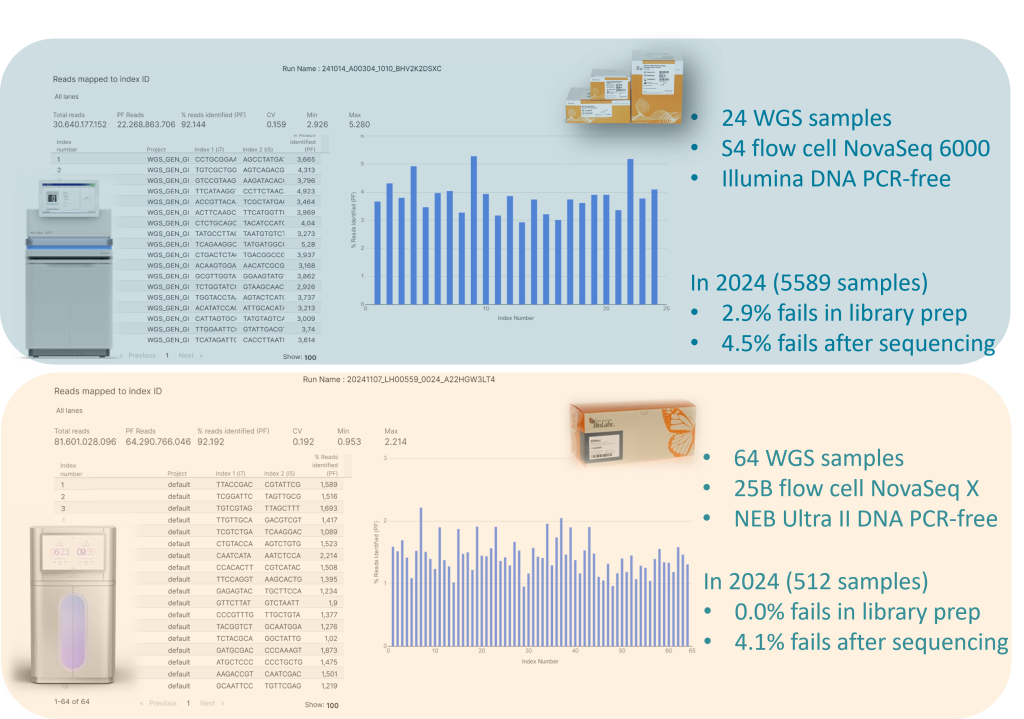
After incorporating Covaris R230 mechanical shearing alongside an NEB Ultra II PCR-free library prep kit, library prep failure rates dropped to 0.0% (n=512 samples), compared to 2.9% for the prior tagmentation-based workflow (n=5,589 samples), in 2024 data. Source: Tom Hofste, PhD, Radboud University Medical Center, ESHG 2026.
For the current short-read WGS workflow, approximately 500 nanograms of DNA is used as input, with Covaris shearing targeting an insert size of approximately 400 base pairs.
Across roughly 18,500 short-read genome samples, the laboratory has achieved a mean insert size of approximately 400 base pairs. Current library preparation failure rates are below 1%, while duplicate reads remain stable below 15%.
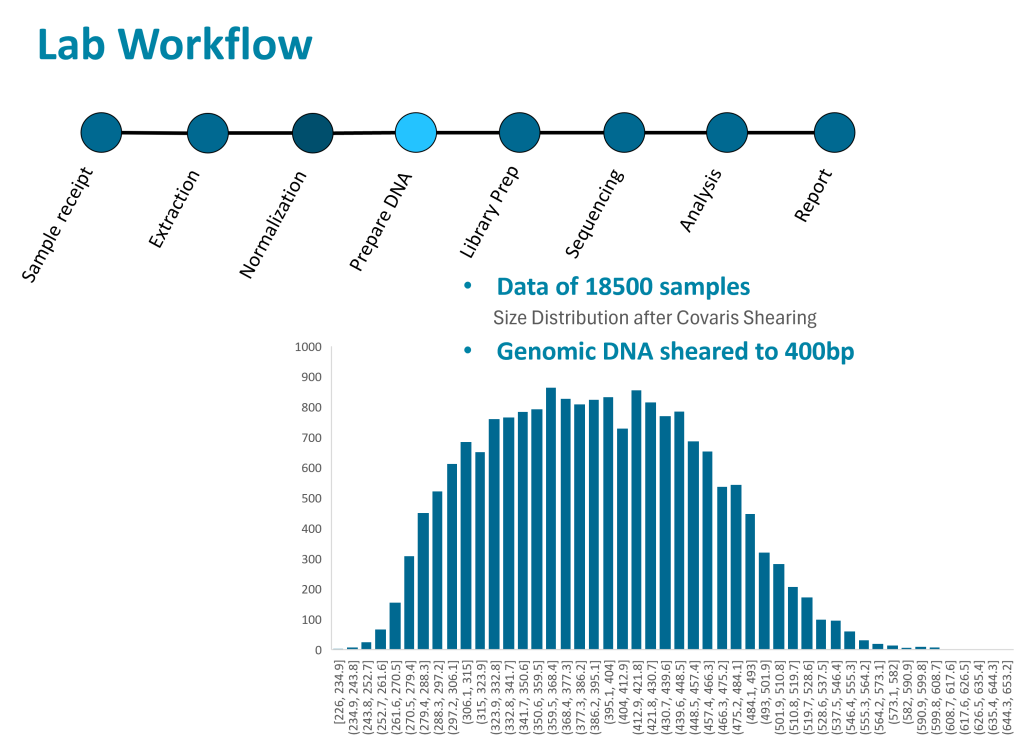
Fragment size distribution across ~18,500 WGS samples sheared with Covaris R230. Source: Tom Hofste, PhD, Radboud University Medical Center, ESHG 2026.
The approximately 400-base-pair insert length also supports 2 × 150 bp sequencing without read overlap while maintaining strong Q30 performance.
Extending Automation to Long-Read Genome Sequencing
Alongside its short-read workflows, Radboud UMC is developing automated long-read genome diagnostics using PacBio sequencing.
This workflow requires a different fragmentation approach. The laboratory uses automated tip shearing on a Hamilton liquid handler to generate DNA fragments of approximately 16 kilobases. The long-read workflow represents another stage in the laboratory’s broader transition from exome sequencing toward increasingly comprehensive genome-based diagnostics.
From Exome Automation to Genome-Scale Diagnostics
Radboud UMC’s experience demonstrates how clinical sequencing workflows can evolve as diagnostic volumes and technologies change. What began with manual exome sequencing progressed to high-throughput exome automation and, more recently, automated short-read whole genome sequencing at substantial scale.
Across these workflows, controlled DNA fragmentation and integration with liquid-handling automation have helped the laboratory maintain consistent fragment sizes and sequencing quality while increasing throughput. Radboud UMC is also collaborating with Covaris to evaluate the truCOVER® Whole Genome Sequencing Kit within their diagnostic pipeline, with full results to follow as that work continues. As the laboratory continues developing both short- and long-read genome diagnostics, its experience provides a practical example of how high-throughput DNA sequencing can be implemented and optimized for routine clinical genomics.
Related reading note: This work builds on Radboud UMC’s earlier work scaling WES and WGS automation. Read the first chapter here.