Unlocking FFPE Tumor Samples: A Novel Covaris and PacBio Workflow for HiFi Long-Read Sequencing
Presented Deborah Moine, Senior Product Manager, Sample Preparation, PacBio.
Formalin-fixed paraffin-embedded (FFPE) samples represent a significant resource for cancer genomics due to their linkage with pathology information, treatment history, and clinical outcomes. However, formaldehyde fixation introduces DNA damage, including protein-DNA cross-links, resulting in low-quality DNA that has historically limited long-read sequencing FFPE analysis. This presents a barrier to fully utilizing these valuable clinical samples.
The Utility of Long-Read Sequencing FFPE Samples in Oncology
The complexity of the cancer genome necessitates advanced sequencing approaches. While single nucleotide polymorphisms (SNPs) are critical, comprehensive oncological profiling also requires the analysis of structural variants, repetitive regions, and haplotype phasing. PacBio HiFi sequencing is an optimal tool for evaluating these parameters, particularly for whole transcriptome sequencing (WTS), comparative variant detection, phasing, and structural variant analysis.
The HiFi sequencing process traditionally begins with high molecular weight DNA. SMRTbell adapters are ligated to both extremities of the molecule to create a circular structure, and a polymerase is bound to one extremity prior to sequencing on instruments such as Vega or Revio. This process generates polymerase read lengths exceeding 100 kb. Sub-reads are subsequently aligned to produce a single HiFi read with over 99.9% accuracy. Consequently, HiFi reads provide long read lengths of up to 25 kb with accuracy comparable to, or exceeding, short-read technologies.
The Integrated Covaris and PacBio Workflow
To overcome the limitations of FFPE-derived DNA, an integrated workflow utilizing Covaris and PacBio technologies has been developed, enabling reliable long-read sequencing FFPE analysis. This end-to-end solution addresses both DNA extraction and library preparation:
Covaris Extraction: The workflow utilizes the truXTRAC® FFPE SMART Solutions extraction protocol to recover longer DNA fragments and improve overall DNA quality from FFPE tissues.
PacBio Library Preparation: The extracted DNA undergoes amplification to increase yield, followed by Kinnex PCR to concatenate the DNA into artificially long molecules suitable for long-read sequencing.
Study Design and Sequencing Performance
The efficacy of this workflow was evaluated using two to four FFPE tissue scrolls from kidney, uterine, and brain tumors. The protocol required an initial input of approximately 50 nanograms of DNA and was completed from extraction to sequencing in approximately two days.
- Sequencing output demonstrated robust performance across all evaluated samples:
- Total generated reads exceeded 100 million per sample prior to bioinformatic processing.
- Following the bioinformatic separation of the artificially concatenated long molecules back into the original FFPE inputs, the actual number of sample reads ranged from 110 million to 160 million.
- Mean sequencing coverage varied between 12x and 34x, which correlated directly with the size of the DNA extracted via the Covaris protocol.
Comprehensive Variant Detection and Phasing
The resulting read lengths proved highly effective for downstream variant analysis. Key analytical findings included:
- Identification of approximately 11,000 structural variants per sample.
- Detection of over 5 million SNPs per sample.
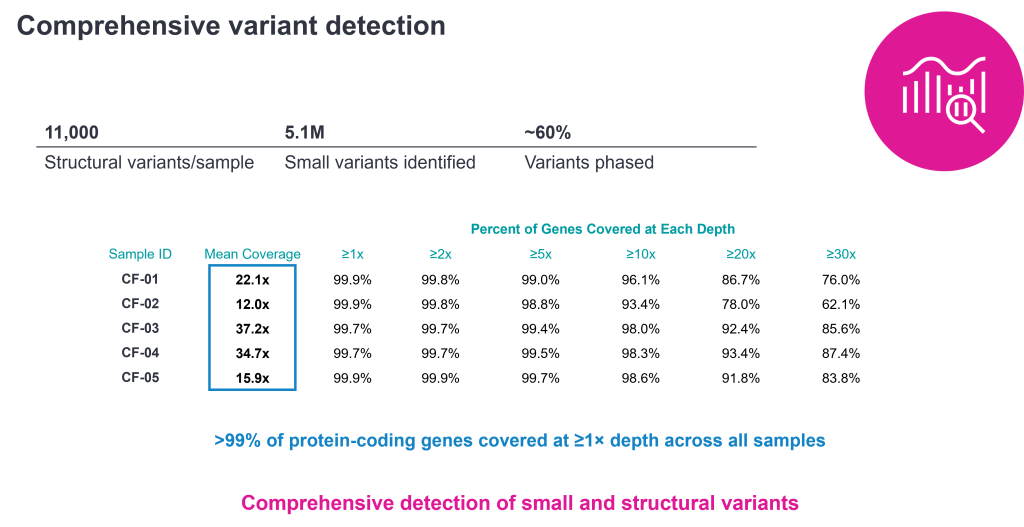
Comprehensive variant detection across five FFPE tumor samples — 11,000 structural variants and 5.1M small variants per sample, with >99% of protein-coding genes covered at ≥1× depth. Source: Deborah Moine, PacBio, Covaris ESHG Workshop, June 2026.
- Successful phasing of 60% of the identified variants.
- Effective phasing of human leukocyte antigen (HLA) loci, specifically when sample fragments exceeded 1 kb in length.
- A direct correlation between longer read lengths and improved phasing capabilities.
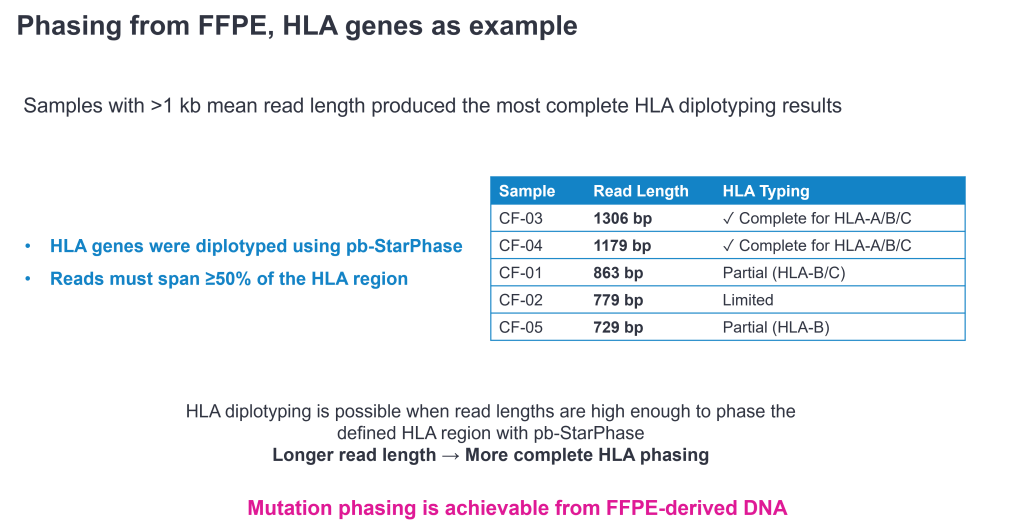
HLA diplotyping completeness by sample read length — longer reads (>1kb) produced complete HLA-A/B/C typing, demonstrating that mutation phasing is achievable from FFPE-derived DNA. Source: Deborah Moine, PacBio, Covaris ESHG Workshop, June 2026.
Curious how this workflow stacks up against traditional short-read approaches? Covaris and PacBio’s joint partnership announcement has more. Read the press release
Conclusion
The integration of Covaris truXTRAC extraction and PacBio Kinnex library preparation provides a functional, end-to-end workflow for the comprehensive analysis of FFPE samples using HiFi long-read sequencing. This methodology enables robust variant detection and phasing, expanding the utility of historical FFPE tumor samples in advanced genomics applications.