Optimizing Melanoma Therapy Through AI-Enhanced Digital Pathology and Molecular Profiling in Large Scale Biobanks
Synthesizing Precision: How High-Throughput Proteomics is Rewiring Melanoma Research
Peter Horvatovich, PhD
Professor, Computational Proteomics, University of Groningen, The Netherlands
ASMS 2026
At the 2026 American Society for Mass Spectrometry (ASMS) conference, Covaris proudly sponsored a symposium highlighting the intersection of advanced proteomics and precision oncology. The presentation detailed how an international research consortium is leveraging FFPE proteomics for melanoma research, using the Covaris R230 to accelerate the discovery of targeted therapies for malignant cutaneous melanoma.
The Digital Twin Initiative
Malignant cutaneous melanoma accounts for 85 to 90 percent of deaths related to skin cancer. While early-stage detection yields a 90 to 98 percent treatment success rate, metastasis to lymph nodes or multiple organs drastically lowers these outcomes. To optimize precision treatments, researchers are operating under the U.S. Cancer Moonshot program to develop “patient digital twins”. This initiative integrates clinical metadata with high-fidelity multi-omics profiling from patient tissue to perfectly tailor treatments.
At the core of this initiative is the Lund University biobank, operating at an industrial quality level with an archive of roughly 5,000 samples from approximately 2,000 patients across multiple countries. Because proteins serve as the functional units of tissue and primary drug targets, proteomics is critical to optimizing this complex clinical data.
Covaris R230: Powering High-Throughput FFPE Proteomics for Melanoma Biobanks
Processing large cohorts of clinical sample batches require workflows demonstrating high reproducibility, robustness, speed, and reliability. To achieve this, the research team integrated the Covaris R230 high-throughput focused ultrasonicator into their workflow. This contactless, non-invasive, automatable workflow allows for seamless sample tracing and integration into local software environments.
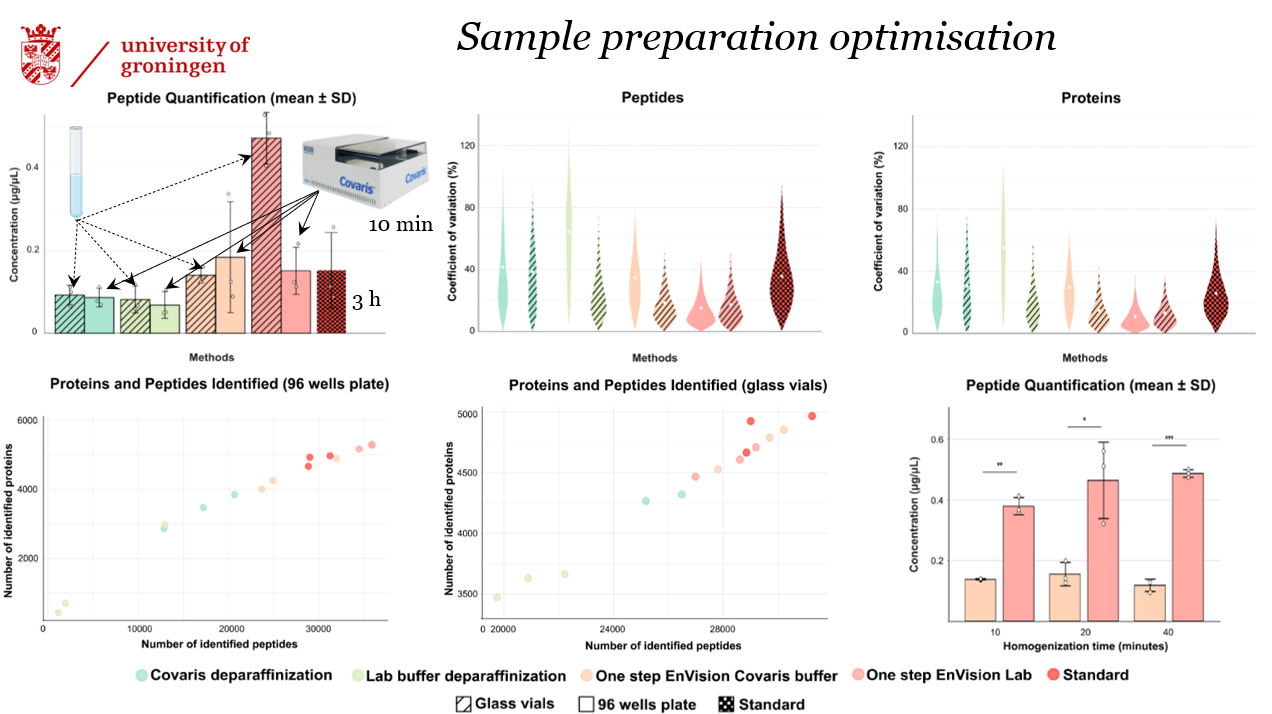
During protocol optimization for Formalin-Fixed Paraffin-Embedded (FFPE) tissues, the Covaris workflow outperformed their existing lengthy methodologies:
- While a one-step deparaffinization using the Covaris buffer yielded superior reproducibility, the team ultimately optimized their final five-minute workflow using a one-step deparaffinization with an SDS buffer.
- The optimized Covaris protocol could identify ~5,000 proteins/sample in a very reproducible format.
- The comprehensive workflow significantly reduced processing time compared to hard-to-automate glass vial methods, providing sufficient protein concentration for high-throughput profiling.
Decoding the Matrix: Rare Subtypes and the Warburg Effect
The automated workflow mapped four known melanoma subtypes, extracting distinct multi-omics profiles from each. A primary focus was placed on acral lentiginous melanoma (ALM), a rare, aggressive, non-UV-exposed subtype occurring on nails, palms, and soles. By performing differential expression analysis, researchers uncovered critical molecular shifts:
- ALM samples exhibited upregulated accessory matrix reorganization and increased .
- Lipid metabolism, branched-chain amino acid catabolism, and chromatin remodeling were highly downregulated in ALM.
- Researchers identified a key downregulation of the ATP5 inhibitor factor 1, which typically acts on mitochondrial complex V.
- The absence of this protective inhibitor allows uninhibited glycolysis, driving the aggressive Warburg effect (a metabolic process where cancer cells preferentially produce energy via glycolysis and lactic acid fermentation) in ALM tumors.
Scaling the Future
The pilot study successfully demonstrated that the Covaris sample prep workflow with the R230 enables parallel, automated, high-throughput FFPE proteomics for melanoma research at biobank scale. By uncovering key inhibitory regulators in rare cancer forms, the consortium is now scaling this workflow to process its entire 5,000-sample archive. Through these advanced multiomic profiles, clinical researchers are closer than ever to synthesizing perfect digital twins and delivering precision treatments for melanoma patients.