DNA Methylation Sequencing: A Streamlined FFPE Workflow
DNA Methylation Sequencing: A Streamlined FFPE Workflow
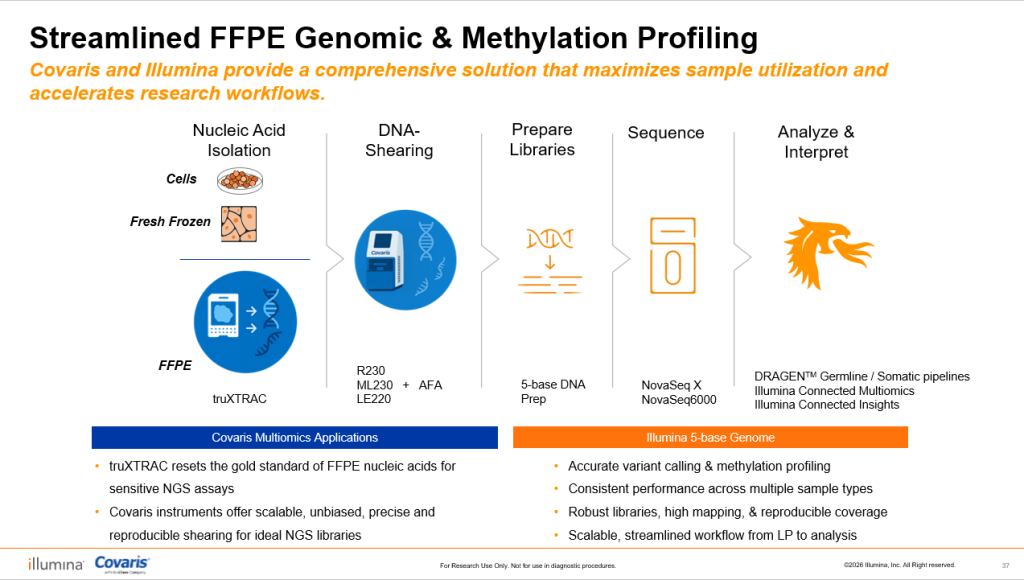
Workflow diagram: truXTRAC FFPE extraction, Covaris R230 shearing, Illumina 5-Base library prep, sequencing, and DRAGEN analysis
Researchers working with formalin-fixed, paraffin-embedded (FFPE) tissue know the tradeoff all too well: methylation data and genomic variant data typically require separate assays, separate library prep workflows, and separate rounds of precious, often-degraded sample processing iteration. At AACR 2026, Covaris and Illumina presented data addressing that tradeoff directly, showing how DNA methylation sequencing and genomic variant detection can be captured from a single FFPE sample in one streamlined workflow.
Greg Endress, Senior VP of Technology and Innovation at Covaris, and Smriti Sharma, Staff Product Manager on Illumina’s Multiomic Library Prep team, co-presented the session. Their talk walked through the combined Covaris–Illumina workflow: truXTRAC® extraction, Covaris Adaptive Focused Acoustics® (AFA®) shearing, and Illumina’s 5-Base solution, and shared new data from matched tumor and normal lung FFPE samples.
Why DNA Methylation Sequencing Needs Genomic Variant Data, Too
Illumina’s 5-Base solution is built around a single-step enzymatic conversion that directly converts 5-methyl-cytosine to thymine. Because the conversion targets methylated cytosines specifically, rather than converting the vast majority of unmethylated cytosines as older methods do, the resulting libraries retain more sequence complexity. That translates into better mapping efficiency and higher-confidence variant calls, alongside the methylation data, from the same sequencing run.
The practical benefit for labs is fewer assays per sample, less bioinformatic reconciliation between separate genomic and methylation datasets, and lower overall cost for studies that need both layers of information. This is a meaningful consideration for large-scale cancer or epigenomics research where sample and budget are both limited.
How DNA Methylation Sequencing Differs from Whole Genome Bisulfite Sequencing
Whole genome bisulfite sequencing (WGBS) has long been the standard for methylation profiling, but it comes with well-documented costs. Bisulfite treatment converts unmethylated cytosines to uracil through a harsh chemical reaction that degrades DNA, reduces library complexity, and can result in significant loss of usable input material. That damage limits the technique’s usefulness on already-fragmented, lower-quality sample types like FFPE tissue.
The 5-base solution takes the opposite approach: instead of converting the bulk of the genome, it converts only the methylated fraction. In the presentation Q&A, the presenters noted that despite this fundamentally different chemistry, methylation conversion accuracy measured against EM-seq/NEB bisulfite, which is still considered the gold standard, showed comparable true-positive and false-positive rates, without the degradation penalty associated with traditional WGBS.
FFPE DNA Extraction and Shearing Performance
The presentation’s FFPE data centered on a defined chain: truXTRAC extraction, AFA-based DNA shearing on the Covaris R230 Focused-ultrasonicator, Illumina 5-Base library prep, sequencing on NovaSeq X, and analysis through Illumina DRAGEN, Illumina Connected Multiomics (ICM), and Illumina Connected Insights (ICI).
Cell-line FFPE model
Using the K562 cell line as both a genomic DNA control and an FFPE-embedded comparator, the team extracted samples with Covaris truXTRAC kits and sheared them on the R230 to a 200-base-pair target, the fragment size optimized for FFPE input. At the recommended 50-nanogram input, this produced high-yield libraries with mean insert sizes over 200 base pairs, good mapping, and no distortion of methylation signal.
Real tumor and normal FFPE samples
The presenters then moved from cell-line controls to a real, matched non-small cell lung cancer (NSCLC) tumor and normal FFPE sample pair — a harder test case. The tumor biopsy was staged pT2a pN0 (AJCC 8th edition), histologically classified as invasive squamous cell carcinoma, non-keratinizing, grade G3 (poorly differentiated). Tape station traces showed Covaris truXTRAC kits reproducibly extracted intact, high-quality DNA from these challenging samples, and R230 shearing again hit the 200-base-pair target without post-shear cleanup. Sequencing metrics for coverage, mapping, and insert size were consistent between tumor and normal samples, and the team reached its 100x coverage target for somatic variant calling.
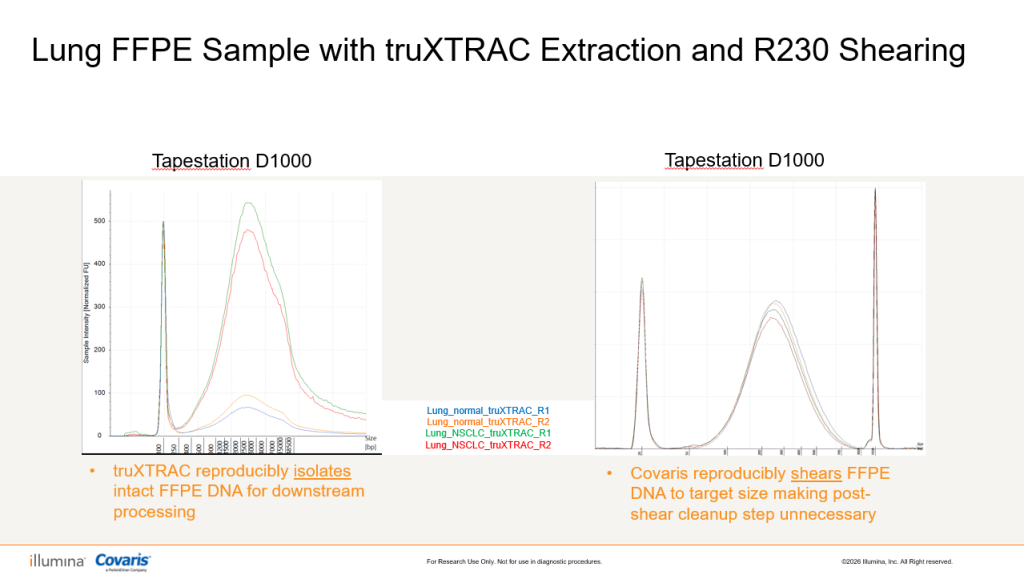
Tapestation traces showing DNA fragment size distributions after truXTRAC extraction and DNA fragment distribution after R230 shearing of lung FFPE tumor and normal samples
Biological Insights from the FFPE Data
Beyond workflow metrics, the tumor/normal comparison surfaced methylation patterns consistent with established cancer biology: global hypomethylation in tumor samples relative to matched normal tissue, a recognized hallmark linked to genomic instability, alongside locus-specific hypermethylation at promoter regions of tumor suppressor genes. GAPDH, a housekeeping gene, served as stable control across comparisons.
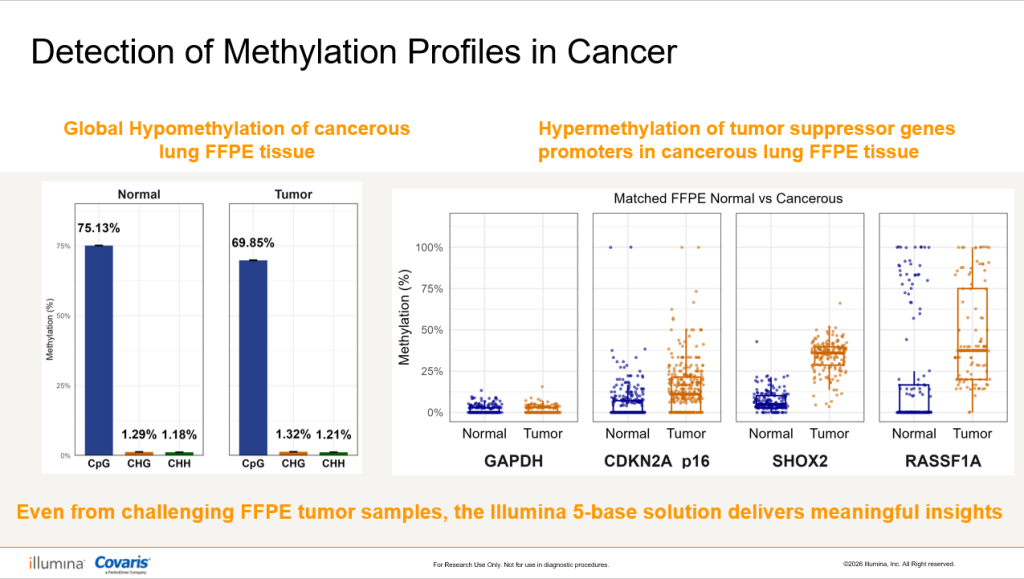
Bar charts comparing global hypomethylation and tumor suppressor gene hypermethylation in FFPE lung tumor versus normal tissue
The team also demonstrated that somatic variant calls (analyzed through ICI) and differential methylation regions (analyzed through ICM, visualized as a volcano plot) could be generated from the same 5-base dataset, allowing researchers to layer variant and methylation information for downstream pathway analysis without running separate assays.
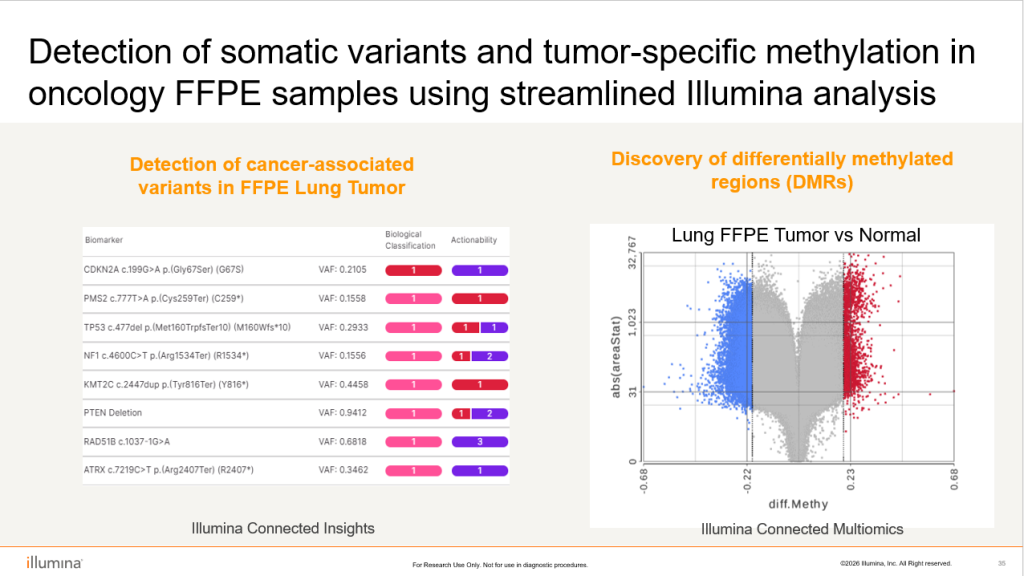
Volcano plot of differentially methylated regions between FFPE lung tumor and matched normal samples
Consistency Across Instruments and Sample Types
A separate arm of the study used genome-in-a-bottle reference samples (HG001 and HG002) at 50 and 100 nanogram DNA inputs, sheared on either the Covaris R230 or ML230 before library prep and sequencing. Across both instruments and both input amounts, the team reported proportional yield, comparable coverage and mapping, consistent insert size, and no meaningful difference in methylation calls. This indicated that lab throughput needs (R230 for high-throughput, ML230 for mid-throughput) don’t come at the expense of data quality. Methylation conversion consistency was also confirmed via a pUC-Lambda control across every sample type, input level, and platform tested.
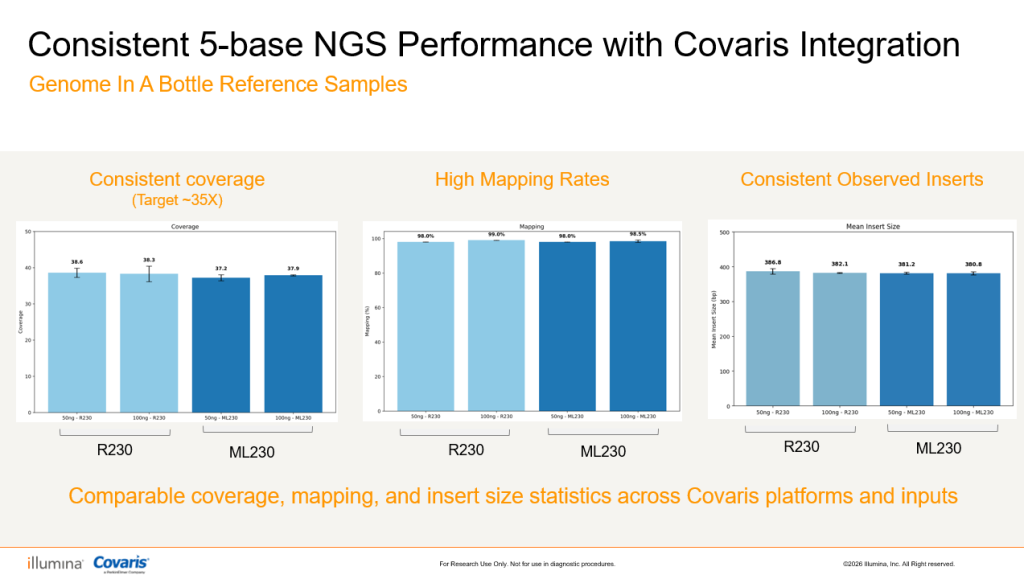
Bar charts comparing coverage, mapping rate, and insert size for DNA methylation sequencing libraries on Covaris R230 and ML230
What Attendees Asked
Audience questions during the session covered a few points worth noting for labs evaluating the workflow:
- Concordance with methylation array data was reported around 0.96, with arrays and NGS positioned as complementary rather than interchangeable methods.
- No decrease in limit of detection was observed when calling methylation and genomic variants from the same library, compared to running each individually.
- Enrichment-based testing achieved variant detection down to 0.5% VAF without any impact to methylation conversion accuracy.
- The workflow extends to cell-free DNA, with sample-specific shearing settings available through Illumina’s application support team for labs running the Covaris ME220.
The Takeaway
For labs balancing precious FFPE sample against the need for both genomic and epigenomic data, this Covaris–Illumina workflow offers a way to get both from a single extraction, a single shear, and a single library, without the DNA damage tradeoffs of bisulfite-based DNA methylation sequencing. The data presented at AACR 2026 spanned reference standards, cell-line FFPE models, and real tumor/normal tissue, with consistent performance across all three.
Labs interested in applying this workflow to their own FFPE samples can reach out to Covaris application support for extraction and shearing parameters specific to their instrument and sample type.