Integration of Covaris R230 for C. elegans High-Throughput Proteomics Sample Preparation
Sample Preparation for High-Throughput Proteomics: Integrating Covaris R230 for C. elegans Workflows
Valentine Courouble, Ph.D.
Postdoctoral Fellow, AAC Mass Spectrometry, NCATS
&
Dingyin Tao, Ph.D.
Team Lead, ACC Mass Spectrometry, NCATS
ASMS 2026
At the 2026 American Society for Mass Spectrometry (ASMS) conference in San Diego, CA, researchers Courouble and Tao from the National Center for Advancing Translational Sciences (NCATS) presented new advances in proteomics sample preparation while working with C. elegans. Their presentation detailed the integration of the Covaris R230 Focused-ultrasonicator to develop a robust workflow for processing complex multicellular organisms, specifically C. elegans, to support translation science initiatives including drug target discovery and biomarker identification.
Overcoming Bottlenecks in C. elegans Proteomics Sample Preparation
Typical bottom-up proteomics workflows face several limitations including low-throughput manual sample preparation, which in turn limits sample processing to not more than 20 – 30 samples/day. To address this limitation, NCATS developed an automated platform capable of processing over 300 cultured cell samples in four hours and comparable volumes of clinical serum samples in three hours.
Adapting this high-throughput system for multicellular organisms like C. elegans presents unique challenges. While C. elegans is a vital model organism for quantitative high-throughput pharmacological screening, its thick outer cuticle can cause inefficient lysis resulting in variable protein yield and quality. Traditional lysis methods, such as manual grinding or solvent extraction, lack the necessary reproducibility and are incompatible with high-throughput automation.
Implementing Covaris AFA® Technology for Complex Lysis
To enable automated processing of C. elegans, the researchers at NCATS utilized Covaris’ Adaptive Focused Acoustics® (AFA) Technology. The Covaris systems provide non-contact extraction within a temperature-controlled environment and are scalable up to a 384-well format.
Key milestones achieved using Covaris AFA technology include:
- The robust workflow developed at NCATS successfully and reproducibly yielded high quality and quantity of proteins from elegans.
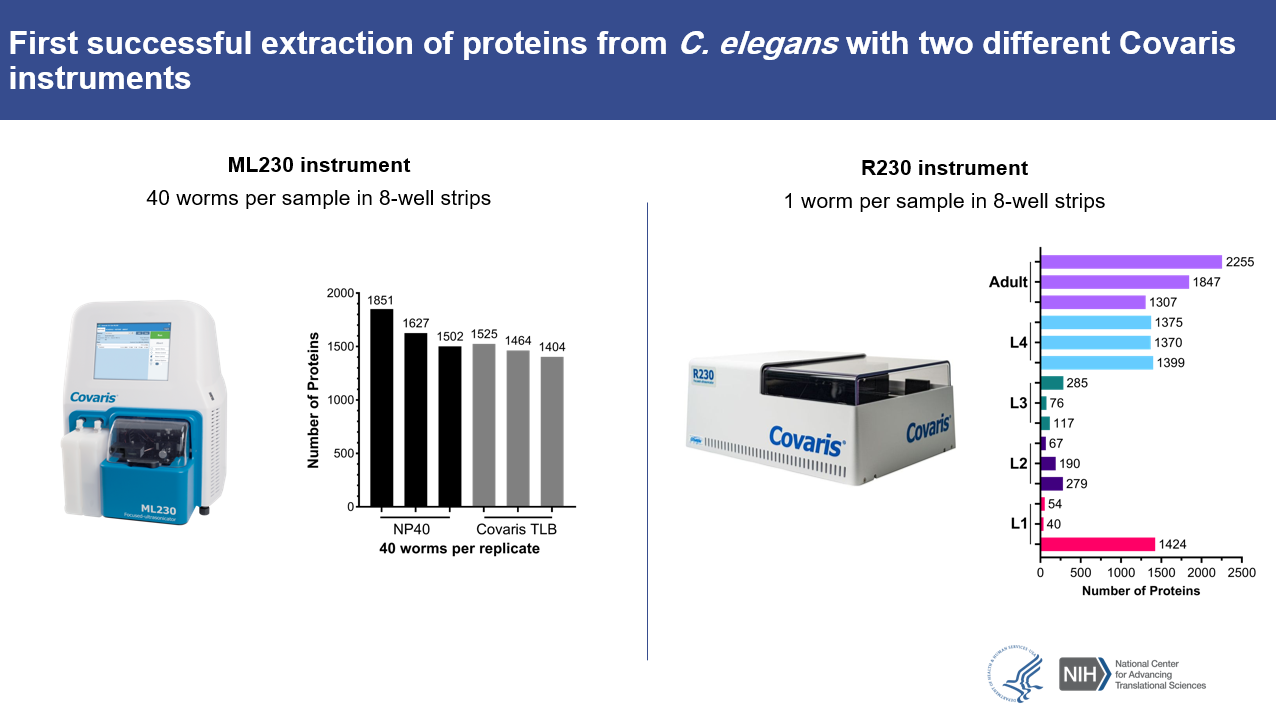
- Initial testing with the ML230 focused-ultrasonicator with a batch of 40 worms in eight-well strips identified approximately 1,500 proteins/sample.
- The R230 enabled workflow allowed for single-worm processing in eight-well strips.
Adult single-worm samples yielded up to 2,000 protein identifications.
- L1 stage single-worm samples, containing roughly 100 nanograms of protein resulted in successful identification of ~1,000 proteins/sample.
Workflow Optimization and Scalability
The automated lysis step was subsequently integrated with automated S-S reduction, Cys-alkylation, and Tryptic digestion steps utilizing an Agilent Bravo liquid handling platform. Initial results revealed a marked decrease in protein identification efficiency and reproducibility, leading to the need for further optimization of digestion and liquid transfer protocols.
Following optimization, the expanded high-throughput workflow demonstrated significant performance improvements. Some of the key modifications include:
- Harvesting and lysing worms directly in 384-well plates with the R230 eliminated manual transfer steps.
- The fully integrated 384-well protocol resulted in a 1.5-fold increase in protein identification across multiple life stages.
- Overall sample processing time was reduced from two days to eight hours for up to 384 samples.
Miniaturized TMT Labeling to Maximize Mass Spectrometry Throughput
While sample preparation time was drastically reduced, LC-MS data acquisition remained a bottleneck, requiring 120 minutes/run, which amounted to >32 consecutive days to analyze a full 384-well plate. To mitigate this, the researchers implemented Tandem Mass Tag (TMT) multiplexing.
Standard TMT workflows require 25 to 50 µg of protein and manual processing in Eppendorf tubes. The NCATS team successfully miniaturized this workflow into a 384-well plate format to accommodate the 100 to 200 ng of protein obtained from single-worm samples.
The miniaturized TMT protocol delivered the following quantitative results:
- Labeling was successfully performed on as little as 100 ng of protein using a 1:100 peptide-to-TMT ratio.
- LC-MS acquisition time for the life stage analysis was reduced from 33 hours to 3.5 hours.
- Starting material requirements were reduced by over 250-fold.
- TMT reagent consumption was decreased by 12.5-fold.
- Overall LC-MS throughput was increased by more than 14-fold, enabling a sample-to-data turnaround time of three days.
Future Applications
The automated high-throughput platform at NCATS has demonstrated that scalable proteomics sample preparation of C. elegans is now achievable, with efficient processing of adherent cells, serum, and whole organisms in a single automated workflow. The integration of the workflow with Covaris R230 focused-ultrasonicator directly enables the processing of complex sample types. Future initiatives will focus on expanding this platform to process tissues, 3D organoids, and suspension cells.